News & Insight

Crocs lose their grip: what loss of registered EU design says about overall impression, filing strategy and limits of product fame
How can one of the world’s most recognisable products lose its registered design protection?
That question sits at the heart of the General Court’s recent decision in Crocs v EUIPO. The answer is not that the Crocs clog lacks originality, commercial success or consumer recognition. Rather, the case serves as a reminder that registered design protection operates according to its own rules. A product can become instantly recognisable in the marketplace yet still fall short when tested against the requirements of design validity.
For businesses that invest heavily in product design, the judgment offers three important lessons. First, design law is concerned with overall impression, not commercial fame. Secondly, a feature that consumers strongly associate with a product may not be enough if the rest of the design remains too close to the prior art. Thirdly, and perhaps most practically, timing matters.
The dispute
The case concerned Crocs’ registered EU design for its well-known clog. The registration claimed priority from May 2004 and depicted the familiar footwear shape including a rounded toe, thick sole, perforated upper and rear heel strap:
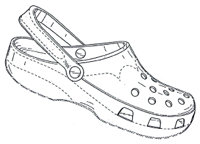
The design was challenged by a Spanish company relying on an earlier clog design known as ‘Holey Soles’. That design had been publicly disclosed in April 2003, more than a year before the Crocs priority date:

The EUIPO Invalidity Division found the Crocs design invalid. The Board of Appeal agreed. The matter ultimately reached the General Court, which upheld the invalidity decision.
At one level, the dispute was straightforward. The Court was required to determine whether the Crocs design produced a different overall impression on the informed user when compared with the earlier design.
Its answer was that it did not.
Why recognisable does not necessarily mean protectable
One reason the judgment has attracted attention is that many people would instinctively regard the Crocs clog as distinctive. That reaction, however, illustrates the difference between marketplace recognition and the legal assessment required under EU design law.
The Court was not concerned with whether consumers could identify the product as a Crocs clog. Nor was it concerned with the commercial success of the product, its cultural significance or its reputation in the marketplace. The question was whether the registered design created a sufficiently different overall impression from the earlier design already available to the public.
That distinction is sometimes overlooked. Businesses naturally focus on the features that customers notice and remember. Design law asks a different question. It requires a comparison between the design and the relevant prior art, viewed through the eyes of the informed user.
A design’s success in the market may explain why it is valuable. It does not necessarily explain why it is valid.
The limits of a single distinguishing feature
Crocs argued that the key point of distinction was the heel strap incorporated into its design. For many consumers, that is understandable. The pivoting heel strap is one of the most recognisable aspects of the Crocs product and contributes to its appearance and functionality. The Court nevertheless concluded that the strap was insufficient to alter the overall impression created by the design as a whole.
The reason was not that the strap was ignored. On the contrary, the Court accepted that an informed user would notice it. The difficulty for Crocs was that the two designs were otherwise extremely similar. Both featured the same essential clog configuration, including a thick sole, rounded closed toe, perforated upper and similar arrangement of openings. Viewed as a whole, the similarities outweighed the difference created by the strap.
The decision therefore reinforces a principle that appears repeatedly in European design case law. Individual character is assessed holistically. A design owner cannot assume that a single point of difference will be enough if the overall appearance remains substantially unchanged. In practical terms, this means that the feature a brand regards as its signature element may not necessarily be the feature that determines the outcome of a validity challenge.
A reminder that filing strategy matters
Perhaps the most useful lesson for businesses lies not in the Court’s analysis of the heel strap but in the chronology of the case. The earlier Holey Soles design had entered the public domain in April 2003. Crocs’ relevant priority date was May 2004. By the time the Crocs design was assessed, the earlier design had already become part of the design landscape against which validity had to be judged. That sequence highlights the importance of securing protection early.
Design rights are often discussed in terms of creativity, innovation and visual impact. Equally important, however, is identifying the right moment to file. Delays can have consequences. As time passes, the body of relevant prior art expands and the risk of similar disclosures increases.
The point is not that an earlier filing would necessarily have changed the outcome for Crocs. The facts of every case are different. Rather, the judgment illustrates a broader principle that businesses should treat filing strategy as an integral part of design protection rather than as an administrative afterthought.
This is particularly true where products evolve through multiple iterations. Different versions of a product may each warrant protection. Leaving later variations unregistered can create vulnerabilities.
New legislation, familiar principles
The timing of the decision is also noteworthy. The judgment arrives against the backdrop of the most significant reform of EU design law in more than two decades. Much attention has understandably focused on the modernisation of the legislative framework and its response to technological change. Yet the Crocs decision demonstrates that some of the most important aspects of design law remain unchanged.
The concepts that ultimately decided the case would be familiar to any design practitioner: the informed user, designer freedom, prior art and overall impression. While the legislative framework continues to evolve, these principles remain central to determining whether a design is valid and enforceable.
In that sense, the judgment is a useful reminder that the fundamentals still matter. The Crocs clog remains one of the most recognisable products of modern times. The General Court’s judgment does not change that.
What it does show is that recognition and registrability are different concepts. A product can become iconic in the eyes of consumers while still struggling to satisfy the technical requirements of design law. For businesses seeking to build and protect valuable product portfolios, that distinction is worth remembering.
Humphreys Law are specialists in trade mark registration, disputes and enforcement. If you have any questions or issues concerning the above, contact a member of our team.
All the thoughts and commentary that HLaw publishes on this website, including those set out above, are subject to the terms and conditions of use of this website. None of the above constitutes legal advice and is not to be relied upon. Much of the above will no doubt fall out of date and conflict with future law and practice one day. None of the above should be relied upon. Always seek your own independent professional advice.
Humphreys Law
If you would like to contact a member of our team, please get in touch by filling in the form below.
"*" indicates required fields
Humphreys Law