News & Insight

FCA cuts processing time and increases acceptance rates for crypto firms: closing the stable door after the horse has bolted?
George Osborne, former British chancellor and member of Coinbase’s advisory council , wrote in the FT last month: “On crypto and stablecoins, as on too many other things, the hard truth is this: we’re being completely left behind. It’s time to catch up.” Few if any would disagree with his first sentence. There is a lack of urgency in the UK as to the second.
In January 2020, the FCA became the UK’s anti-money laundering and counter terrorist financing supervisor of businesses carrying out certain cryptoasset activities. Since then, Web3 and crypto businesses that are in scope of the 2017 Money Laundering Regulations have been required to register with the FCA in order to conduct their business here.
That has positioned the regulator as gatekeeper, with registrations accepted only if the FCA determines that the applicant has the necessary systems and controls in place to comply with the 2017 Regulations on an ongoing basis. Those Regulations were not written with decentralised ledger technology in mind and comprehensive compliance for new ventures in the Web3 space sets the bar very high.
The result has been five years during which the applications process has been criticised for being far too slow and the acceptance rate has sat at less than 15%. The Financial Times published these numbers on 21 September 2025:
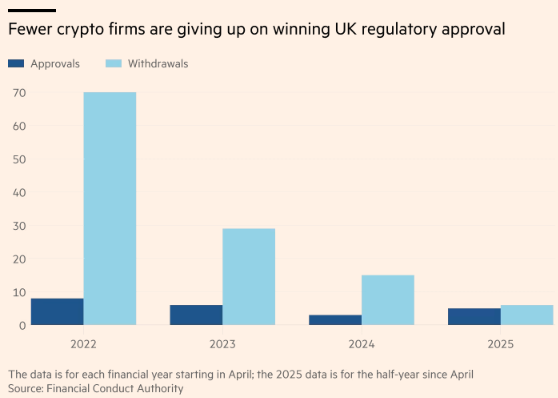
But they picked the wrong headline: for this wave of innovation at least, the stable door has been closed after the horse has bolted to Dubai, Cayman, BVI, and elsewhere (including in some cases the EU) and the US under Trump Mk II has adopted a much more crypto-friendly approach. The UK has lost many bona fide people and businesses as a result, and with a large dollop of irony the fight against money laundering and terrorist financing has arguably been made harder since large sections of crypto industry are being developed without input from the UK but in ways that without too many steps start to touch on UK customers and businesses.
New UK crypto regulation is coming next year, and the plan is to integrate digital assets within the broader regulatory perimeter whilst carving out exemptions for some firms, but if we in the UK are to take the lead we are going to be doing so having moved up from the back of the field.
This piece was written by Henry Humphreys, reflecting his opinions at the time of writing. All the thoughts and commentary that HLaw publishes on this website, including those set out above, are subject to the terms and conditions of use of this website. None of the above constitutes legal advice and is not to be relied upon. Much of the above will no doubt fall out of date and conflict with future law and practice one day. None of the above should be relied upon. Always seek your own independent professional advice.
Humphreys Law
If you would like to contact a member of our team, please get in touch by filling in the form below.
"*" indicates required fields
Humphreys Law